
Technology Case Study
Decarbonizing Industrial Steam
Project Site: New Belgium Brewing - Fort Collins, CO
Technology: AtmosZero ‘Boiler 2.0’ (High-Lift Air-Source Heat Pump)


Purpose & Technology Readiness
This case study was developed for air regulators by Northeast States for Coordinated Air Use Management (NESCAUM) and its consultant, AJW, to showcase the current and near-term capabilities of heat pumps for industrial heat applications. Zero-emission technologies do not require air permits, so the documentation of these technologies being ‘achieved in practice’ is limited.
This case study is focused on the pilot deployment of AtmosZero’s ‘Boiler 2.0’ at New Belgium Brewing in Fort Collins, CO and highlights air-source heat pump technology capable of achieving the high temperatures required by food and beverage manufacturing. This technology is currently at a Technology Readiness Level (TRL)1 of 7, and AtmosZero plans to achieve full technology readiness and begin commercial deliveries in 2027.
Introduction
While space heating and light industrial processes have clear electrification pathways, high-temperature steam (critical for food, beverage, and chemical sectors) has historically relied on fossil fuels due to thermodynamic limits. This project validates a first-of-its-kind “high-lift” heat pump that generates industrial-grade steam directly from ambient air, delivering up to a 200% efficiency gain over fossil-fuel and resistive boilers.
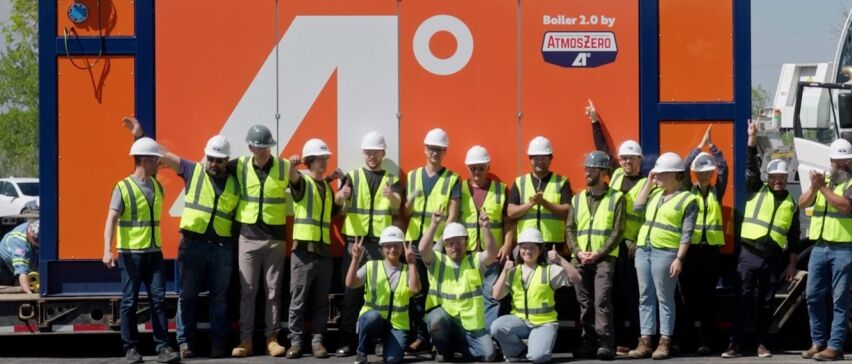
In 2025, New Belgium Brewing in Fort Collins, CO piloted AtmosZero’s ‘Boiler 2.0’ to support baseload from the facility’s natural gas boilers. AtmosZero is also utilizing the project to test features, such as defrost, in a commercial operating environment on a mutually agreed schedule.
New Belgium chose to pilot the heat pump because the drop-in, scalable technology allowed for rapid installation with no production down-time for the brewery.
AtmosZero: Technical Introduction
About AtmosZero
AtmosZero is an industrial heat pump startup that was founded in 2021 to commercialize technology that was developed in co-founder Todd Bandhauer’s lab at Colorado State. The company received a $3.2 million grant from U.S. DOE’s Industrial Efficiency and Decarbonization Office to support product development and a deployment project with a global chemicals company. The pilot project at New Belgium Brewing is the first deployment of its ‘Boiler 2.0’ technology.

Technical Introduction
The AtmosZero system utilizes a proprietary cascading vapor compression loop (two-stage cycle) to “lift” heat from ambient temperatures to steam-producing levels without requiring an external waste heat source.2 Most heat pumps have a single loop or single-stage compression cycle. AtmosZero’s two-stage design is what allows it to generate steam even from air temperatures as low as -14°C. This is one of the fundamental design principles behind AtmosZero’s technology, as utilizing air-source heat pumps instead of waste heat reduces cost and facility downtime during installation.
AtmosZero has designed the ‘Boiler 2.0’ system as a modular, packaged 1 MW (approx. 3,400 lbs/hr steam) unit. The company is focused on mass manufacturing and standardized deployment of industrial heat pumps rather than bespoke installations requiring custom engineering. Current deployments utilize a single unit, but the system is designed to operate in sequence, and their roadmap targets a 3 MW system achieved by three units in sequence. AtmosZero has seen this approach improve CapEx predictability and reduces execution risk compared to bespoke systems.
Heat Pumps and Electrification Emissions Reductions
As with all electrification projects, replacing fuel-fired boilers with heat pumps reduces or eliminates on-site emissions. The total emissions reduction depends on the specific equipment, its role, and whether the fuel-fired equipment is fully retired or remains in use to some extent at the facility. It is worth noting that existing boilers are typically running in partial load, which is much less efficient than the nameplate efficiency ratings.
As an example, this table provides an estimate of onsite CO2e emission reductions from the replacement of a 1 MW natural gas boiler (illustrated at different efficiency levels) with an AtmosZero heat pump.
| Efficiency of Existing 1 MW Natural Gas Boiler | Emissions Reduction with AtmosZero Replacement |
|---|---|
| 85% Efficient | ~1,900 tons of CO2e per year |
| 80% Efficient | ~2,025 tons of CO2e per year |
| 50% Efficient | ~3,200 tons of CO2e per year |
High-Temperature Heat Pump Economics
Project economics for high temperature heat pumps are highly site specific. For early budgeting, AtmosZero’s modular equipment typically ranges from $850,000 to $1,250,000 per unit for equipment cost. The total installation costs (i.e. CapEx) are usually split about evenly between equipment and site integration. Most of the cost variability stems from site integration, particularly electrical infrastructure, so projects with sufficient existing electrical capacity are more cost-effective.
Operating costs also vary greatly depending on the project location. The cost of electricity compared to natural gas (or spark gap), at the project location is the primary determining factor. AtmosZero estimates the total cost of ownership at about $80/MWh. This calculation is based on the assumption of a narrow spark gap of 2.2 with electricity costs at $88/MWh. Additionally, participation in demand response programs, enabled through the technology’s turndown capabilities, and running electric equipment during low-cost hours can provide additional value and reduce operating costs.
As AtmosZero scales deployment, they expect continued cost reductions and standardization, alongside lower operating costs enabled by controls, automation, and remote monitoring.

New Belgium Installation Technical Profile & System Design
About New Belgium
New Belgium Brewing is a leading US premium adult beverage company. Founded in a Fort Collins, CO basement in 1991, New Belgium’s Human Powered Business model of caring for people, protecting the environment, and owning its impact has guided its business practices and enabled New Belgium to reach many significant milestones over the past three decades including becoming the first craft brewery to become a certified B Corp™ still in operation, developing the first carbon-neutral beer in Fat Tire, and much more.
Pilot Setting
Fort Collins, Colorado sits at the base of the Rocky Mountains at an elevation of about 5,000 ft above sea level. Summer temperatures are generally mild, with average winter low temperatures around 15°F (-9.4°C) and a dry climate. These low winter temperatures allow for effective testing of the low temperature limit of AtmosZero’s technology.
In Colorado, the estimated spark gap is 3.2 making it the 13th lowest spark gap of all US states.3 In other words, compared to the rest of the country, the price difference between electricity and natural gas is relatively low.

Technical Specifications
The table below compares the information from the specific installation at New Belgium to the technical capabilities of AtmosZero’s ‘Boiler 2.0’ model.
| Technical Parameter | New Belgium Installed Specification | ‘Boiler 2.0’ Technical Capabilities |
|---|---|---|
| Heat Source | Air-source | Air-source or water-source |
| Low-Temp Limit | Defrost system verified to –14°C (7°F)4 | –20°C (–4°F)5 |
| Output Type | Saturated steam up to 150°C (302°F) (without steam compression) | |
| Steam Compressor | Raises temperature from 150°C to 165°C (329°F) | Capable raising temperature up to 185°C (365°F; 150 psig)6 |
| Design Thermal Output | 650 kW (approx. 2,200 lbs/hr steam) | 1 MW (approx. 3,400 lbs/hr steam) |
| Coefficient of Performance (COP) | 1.3 to 2.5 (Temperature dependent) | |
| Electrical Input | 480V 3-phase | |
| Installation Footprint | Approx. 8' x 27' (Shipping container form factor) | |
| Refrigerant | Non-flammable, low GWP | Ultra-low GWP, low flammability, low toxicity options available |
Implementation: Infrastructure & Deployment
A primary barrier for industry is the “down-time” associated with industrial retrofits. In 2023, New Belgium decided not to pursue a heat pump utilizing waste heat as integration would have been costly and would have required multiple interruptions to brewery production. This project instead utilized a parallel-integration strategy to mitigate operational risk.
- Non-Invasive Integration: Isolation valves were installed during a previously scheduled plant outage. This allowed the AtmosZero unit to be physically placed and interconnected months later with zero production down-time.
- Rapid Deployment: Once the mechanical and electrical infrastructure was in place (60–90 days), the physical unit placement took only one day, followed by a three-week commissioning window.
- Electrical Optimization: The system was designed for low-voltage (~1000 amps) to avoid the need for multi-million-dollar utility transformer upgrades, which often stall industrial electrification projects.7
- Project Management: AtmosZero manages the construction, integration, and commissioning of the project including monitoring of the system post-deployment.
Turndown is another central design consideration for steam electrification as the technology must be able to modulate based on changing baseloads. New Belgium’s loads can vary based on production schedules, cleaning cycles, and other demand variation. AtmosZero reports that its ‘Boiler 2.0’ can modulate from full output down to roughly 30% of rated capacity, allowing it to effectively respond to changes in demand.

Comparative Performance vs. Fossil Baseline
The facility currently operates a hybrid system where the heat pump supports the baseload, and three new natural gas boilers (from manufacturers Miura and Clayton) handle baseload, peaks, and startup.
| Category | Conventional Boilers (Total) | AtmosZero Heat Pump |
|---|---|---|
| Number of Units | 3 | 1 |
| Primary Fuel | Natural gas | Electricity |
| Efficiency (Source-to-Heat) | ~80-85% | > 200% (COP 2) |
| Steam Capacity | ~23,800 lbs/hr | ~2,200 lbs/hr |
| Emissions | Criteria pollutants, air toxics, GHGs | Zero on-site (Scope 1) emissions |
| Role | Peak and redundancy | Primary continuous baseload |
Additional information on new natural gas boilers can be found in New Belgium’s air permit records, the most recent of which are from 2023.8 Notably, AtmosZero’s heat pump is not listed in the facility’s air permits because it is exempt from air permitting requirements.
Key Takeaways
This case study provides three critical “proof points” for air regulators:
- Grid Interaction: The project demonstrates that industrial sites can maintain hybrid thermal plants. This allows facilities to switch to gas during peak grid stress (demand response), making them “grid-friendly.”
- Ambient Air as a Viable Resource: Most industrial heat pumps require 40°C+ waste heat sources to function. This technology proves steam can be generated from ambient air, making it a “drop-in” repeatable product that doesn’t require complex site-specific engineering of waste heat loops.
- Permitting Simplification: As industrial heat pumps generate zero criteria pollutants or air toxics at the site, they offer a streamlined pathway for facilities, particularly those in non-attainment zones, to expand production capacity without increasing their local emissions footprint.
Conclusion
The AtmosZero deployment at New Belgium demonstrates that air-source heat pumps are capable of producing consistent, industrial-grade steam. Existing site infrastructure, available electrical capacity, and the system’s low-voltage design enabled a seamless installation process. This project demonstrates New Belgium’s commitment to testing the latest in sustainable technology, which would enable their breweries to operate in a manner that doesn’t contribute to irreversible climate change.
For industry, this deployment offers an incremental approach to decarbonization. For regulators, it provides a practical example for policies and regulations that prioritize baseload electrification while allowing for gas-based backup during the transition period. It also highlights the importance of electricity pricing, including low spark gap and time-varying rates, in enabling industrial electrification.
About
This case study was developed with data provided by AtmosZero, including information collected through an on-site tour and conversation with the team.
View this case study on the NESCAUM website
Contact
For more information, please contact:


Notes
- Meaning it is being demonstrated at or near full scale in an operational environment. See the US DOE EERE TRL guide. ↩
- AtmosZero’s heat pump technology can be air-sourced, like with New Belgium, or liquid-sourced when low-grade sources of heat are available. ↩
- Spark Gap Calculation by state provided by ACEEE. ↩
- Site utilizes defrost system which runs superheated refrigerant through a heat exchanger. ↩
- The system can still run below -4°F but with reduced capacity and a COP of 1. ↩
- AtmosZero’s roadmap is targeting 200°C. ↩
- Facility-specific electrical capacity is still the major determining factor, but AtmosZero estimates that low-voltage design can avoid the need for transformer upgrades at about 40% of sites. ↩
- New Belgium Brewing’s permit records can be found through the Colorado DPHE Air Pollution Control Division Records Search Tool. ↩