BEYOND PEAK PERFORMANCE:
Why Turndown Determines the Commercial Viability of High-Lift Steam Heat Pumps Expanding the Operating Envelope of Cascaded Centrifugal Steam Modules
Executive Summary
High-temperature steam heat pumps have advanced significantly in lift capability, namely the ability to achieve high temperatures while using very low heat source temperatures from air or liquid sources. However, in real-world applications, load variability—not maximum temperature—is often the determining factor in project success.
Existing steam systems lack practical thermal storage. As a result, heat pumps have historically been viewed as a base-load option only. The ability to modulate the steam load output, i.e., turndown, opens the utility. System turndown directly influences:
- Annual operating hours
- Auxiliary boiler sizing
- Electrical infrastructure requirements
- Levelized cost of heat (LCOH)
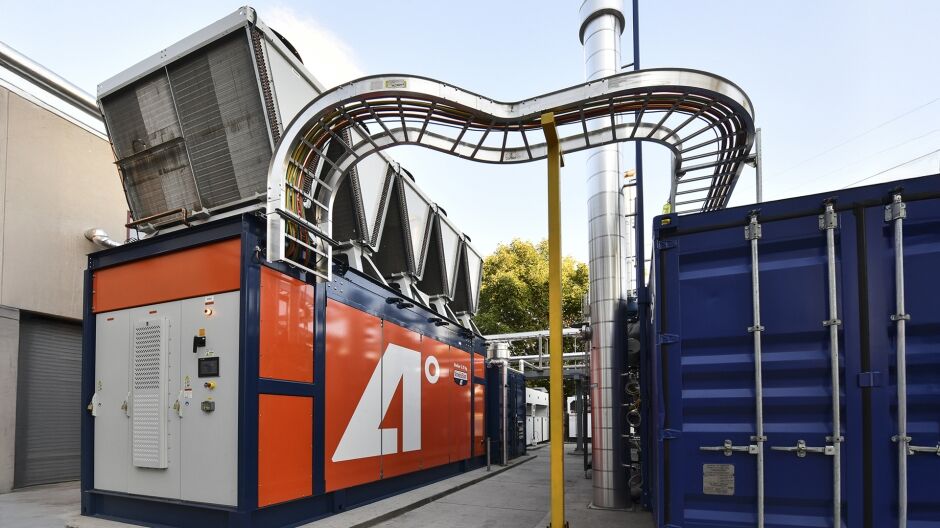
AtmosZero is unique in the sense that its 1 MW cascaded centrifugal steam-generating heat pump achieves ~70% effective turndown (from 100% to ~30% of nominal design capacity), materially expanding viable application space across large commercial and industrial systems.
Diagram 1 – AtmosZero Steam Heat Pump in Various Heat Source Configurations

The Turndown Constraint in Steam Systems
Industrial and commercial electrification efforts increasingly target steam systems. Heat pumps promise lower operating costs than electric boilers and lower emissions than gas-fired boilers. However, while high temperature lift has historically been considered the primary technical barrier, load variability – not lift – is often the true limiting factor in wide-scale project viability.
Steam systems differ fundamentally from hot water systems:
- Steam systems typically lack significant thermal buffer storage.
o Steam accumulators are large, expensive, and rarely sized for sustained load management. - Steam loads can vary significantly due to:
o Batch processes (brewing, sterilization, reactors)
o Seasonal heating demand
o Cleaning cycles (CIP)
o Building distribution asymmetry
Because of this, turndown capability becomes critical.
Traditional industrial heat pumps, especially centrifugal designs, often provide only 20–30% effective turndown (from 100% to ~70% capacity). Below this threshold, systems either cycle on/off or don’t run at all, and auxiliary boilers are required. As a result, many projects revert to electric or gas boilers despite the higher operational cost and emissions penalties.
Compressor Tradeoffs at Scale
All vapor compression heat pumps are fundamentally constrained by compressor design.
Scroll and screw compressors offer relatively more modulation (turndown) but sacrifice efficiency, which is costly at megawatt scales and high lift conditions. Traditional centrifugal compressors offer superior thermodynamic efficiency but have historically struggled with low-flow stability.
This creates a structural tradeoff:
- Use scroll/screw → better modulation, lower efficiency.
- Use centrifugal → higher efficiency, poor load coverage.
Steam applications demand both.
As the system grows in size (kW-> MW), both of these dimensions can become either an engineer’s or an accountant’s headache. Higher turndown (and more run hours) at a higher facility OPEX (lower efficiency), or lower turndown (less run hours) and lower OPEX (higher efficiency). AtmosZero’s revolutionary architecture was developed specifically to bridge this gap.
Cascaded Low-Flow Centrifugal Architecture
AtmosZero’s 1 MW module uses a dual-refrigerant cascaded cycle optimized for ambient-temperature-sourced applications (air or liquid) . The system employs low-flow centrifugal compressors with variable-speed drives in a modular compressor configuration.
Operating Envelope:
Source temperature:
-20°C to 40°C (-4°F to 104°F)
Steam sink temperature:
120°C (15 psig) to 150°C (60 psig) without steam compression
Up to 185°C (150 psig) with steam compression
Thermal capacity:
1 MWth
Performance:
- COP ≥ 2.25 at lower lift (e.g., 90°F ambient to 15 psig steam),
- COP ≥ 1.9 at moderate lift (e.g., 90°F ambient to 50–60 psig steam)
- COP ≥ 1.3 at extreme lift conditions (e.g., -4°F ambient to 50–60 psig steam)
- Electrical input ≈ 500 kW at COP 2 (for 1 MW thermal)
- Efficiency decreases at deep turndown and extreme lift, as expected in vapor compression systems, but operation remains stable and controllable.
This architecture enables both high lift and high efficiency, which drives customer value multi-megawatt scale.
Diagram 2 – Cascaded Centrifugal Steam Heat Pump Architecture

Key features:
- Glycol loop allows for heat source flexibility (ambient air or waste heat) and uniform vapor compression process design
- Dual refrigerant cascade for high lift and commercially available, low GWP, refrigerants
- Variable speed centrifugal compression
Achieving ~70% Effective Turndown
Traditional centrifugal steam heat pumps often operate within a 20–30% turndown envelope. Below this range, stability limits require cycling on/off or shutting down and relying on auxiliary heat input.
AtmosZero’s breakthrough architecture enables effective modulation from full capacity down to approximately ~30% of rated output. This is achieved through proprietary variable speed modulation within stable operating regions and staged compressor operation.
This matters because steam systems have minimal inherent storage.
The result is:
- Continuous steam output through stable operating regions
- Reduced reliance on auxiliary boilers
- Improved load tracking in variable steam profiles
- Rapid load response (60-90 seconds to higher load setpoints)
- From a cold start, ~10 minutes to steam (~5 mins if the steam generator is warm)
Diagram 2 – Load Coverage Comparison

Deeper turndown expands the portion of annual load hours covered by the heat pump, increasing capacity factor and asset utilization.
Application-Level Impact
A. Large Campuses and Commercial Buildings
Consider a 10 MW peak campus heating load:
- Peak load occurs <5% of annual hours
- Seasonal average ≈ 4 MW
- ~4,000 annual heating hours (climate dependent)
Best practice is not to size heat pumps for peak load. Boilers remain ideal for:
- Peak shaving
- Maintenance redundancy
- Emergency backup
However, the key question becomes:
B. How many hours can the heat pump economically operate
Deeper turndown allows the heat pump to cover a larger portion of shoulder-season and mid-load hours. This enables increased annual run hours, i.e., higher utilization of equipment with lower operational expenses, without oversizing the system for infrequent peaks.
If limited to 25% turndown, a heat pump may only cover 30-40% of annual load hours before requiring boiler supplementation.
With ~70% turndown, the same system can cover a substantially larger portion of shoulder-season and part-load conditions.
This increases:
- Annual run hours / capacity factor
- Asset utilization / capital efficiency
Higher utilization directly improves the levelized cost of heat (LCOH).
C. Industrial Steam Systems
In batch processes such as brewing, sterilization, CIP, or reactor heating, steam demand fluctuates rapidly. Unlike hot water systems, steam systems do not commonly incorporate buffer tanks, so they must track load dynamically.
Improved turndown:
- Reduces cycling
- Improves ease of commissioning
- Allows better matching of production windows
- Minimizes auxiliary boiler dispatch
In facilities where steam demand drops significantly outside production windows, modulation capability determines whether the heat pump remains economically active.
Electrical Infrastructure Advantage
Electrical infrastructure is often the dominant hidden cost in electrification projects. Reducing required input capacity can determine project feasibility.
Electric boilers operate at a COP ≈ 1, meaning that a 1 MW thermal output requires approximately 1 MW of electrical input.
At COP 2, a 1 MW thermal heat pump requires approximately 500 kW electrical input.
This reduction can materially decrease:
- Transformer upgrades
- Switchgear expansion
- Utility interconnections
- Feeder sizing
During turndown, electrical input scales with capacity, further reducing instantaneous load. But covering more of the total load profile also means the “peaking” boilers are smaller. In the case of e-boilers, you further reduce your electrical infrastructure as you can downsize the aux boiler and the design electrical load.
Capacity Factor and LCOH
Levelized cost of heat is sensitive to annual utilization. A system operating at limited turndown may only cover 30-40% of annual load hours. Expanding effective turndown can increase coverage, depending on the load profile.
When deeper turndown enables more operating hours:
- Asset utilization increases materially
- Effective LCOH decreases
- Payback period shortens
- IRR improves
Turndown is not merely a technical metric – it is a financial one.
Conclusion
As electrification increases across industrial and commercial sectors, the ability to expand the operating envelope while maintaining thermodynamic efficiency will define next-generation steam systems.
In high-lift applications, the technical conversation has shifted from “Can we reach temperature?” to “Can we operate efficiently across real-world load variability?”
Turndown capability directly influences:
- Annual operating coverage
- Electrical infrastructure sizing
- Auxiliary boiler dependency
- Project-level economics
By expanding effective turndown to approximately 70% in a 1 MW cascaded centrifugal module, AtmosZero’s revolutionary solution materially increases the commercially viable application envelope for electrified steam.
For engineers evaluating steam electrification, turndown should be modeled as a primary design variable, and a technical feature critical to the selection of any steam-generating heat pump.
Contact Sales: